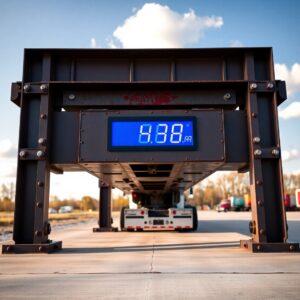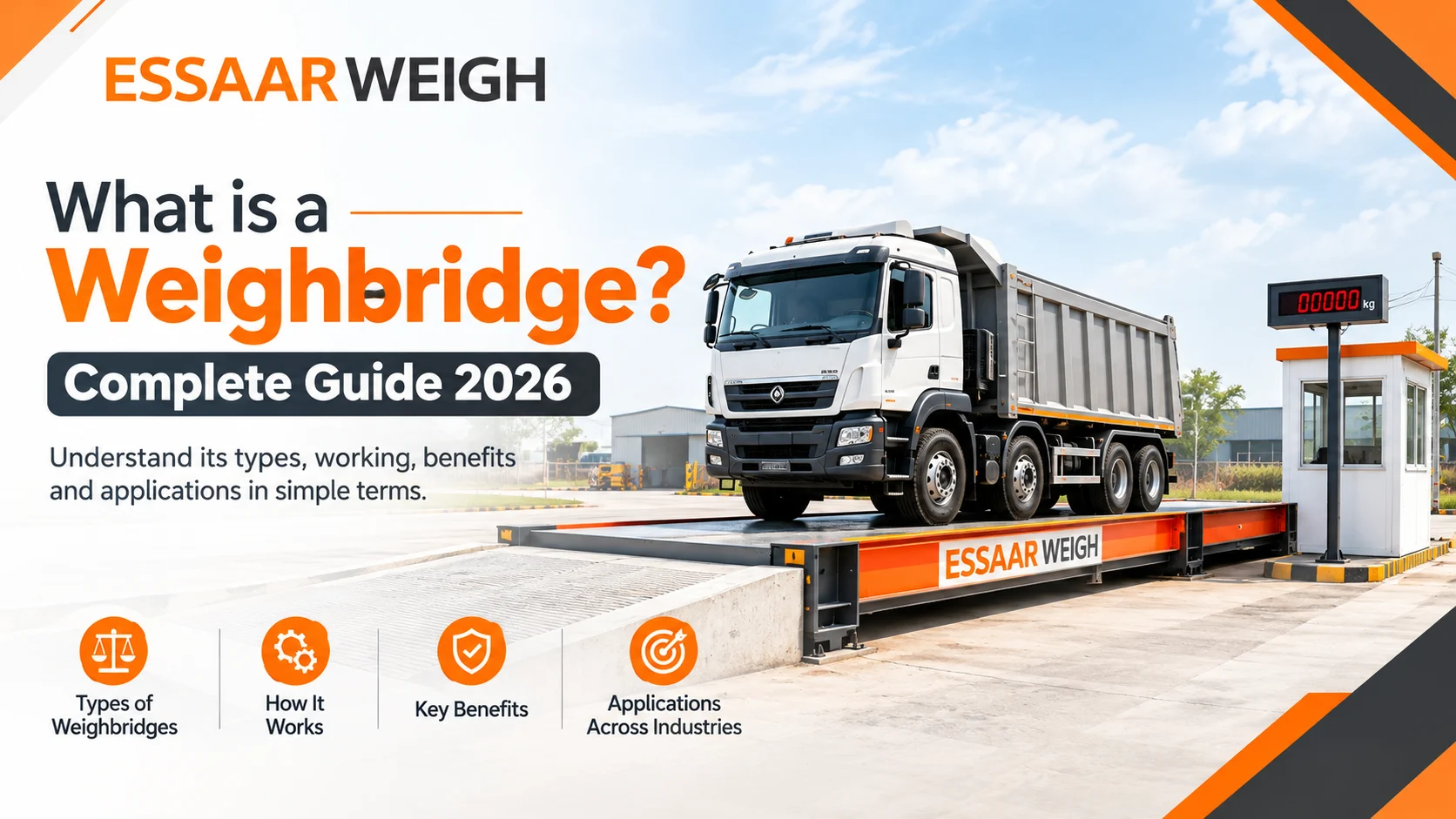
Weighbridges are large-scale industrial weighing systems found in sectors such as manufacturing units, warehouses, logistics hubs, and commercial sites. They are used to weigh trucks, trailers, and other heavy vehicles on a daily basis. A weighbridge accurately measures the weight of vehicles in both loaded and unloaded states, thereby determining the precise quantity of transported material and facilitating the maintenance of accurate weight records for the company.
This guide by Essaar Weigh has been prepared to provide you with comprehensive information about weighbridge systems. Our complete guide can help to explain how a weighbridge operates, understand its key benefits, explore its applications across various industries, and discover how to select and install a weighbridge tailored to your specific needs. The aim is to help you better understand weighbridge systems and facilitate the adoption of the right weighing solution for your industrial operations.
What is Weighbridge?
Weighbridge system, a heavy duty weighing platform used to measure the weight of heavy trucks, trailers, and other commercial vehicles.
Weighbridge is known with different names: truck scale, vehicle scale, lorry scale, or electronic weighbridge.
Load cells installed beneath the platform accurately measure the vehicle’s load and display the exact weight on a digital indicator. This allows for the easy recording of the vehicle’s weight—whether loaded or unloaded—and helps determine the precise quantity of the transported material.
Why is a Weighbridge Important?
If a truck carrying sand, coal, grain, cement, steel scrap, or other bulk materials enters or leaves an industrial facility. If the vehicle weight is estimated or recorded manually, there can be chances of errors. A small mistake in weight calculation can affect material records, billing, inventory, and transportation management.
For accurate measure and systematic record of weight of vehicles this records the weight of loaded and unloaded vehicles and helps to determine actual quantity of material transported by industrial applications.
- Accurately measure loaded and unloaded vehicle weight
- Track incoming and outgoing materials
- Reduce manual weighing errors
- Prevent overloading and underloading
- Maintain proper weighing and transaction records
- Reduce billing and quantity-related disputes
- Improve inventory and material management
- Make vehicle weighing more transparent
- Support transportation and safety requirements
- Improve coordination between suppliers, buyers, and transporters
For business owners, plant managers, procurement teams, logistics teams, and operations managers, a weighbridge is more than just a weighing machine. It acts as an important control point for monitoring vehicle loads, material movement, and weighing records.
How Does a Weighbridge Work?
A weighbridge works by measuring the total weight of a truck or heavy vehicle through load cells installed below the weighing platform. When a vehicle comes onto the platform, its weight creates pressure on the load cells. These load cells convert the applied load into an electrical signal, which is processed by the weighing indicator and displayed as a weight reading.
The complete process is simple and systematic.
Step 1: The Vehicle Enters the Weighbridge
The truck or heavy vehicle enters the weighing area and slowly moves onto the weighbridge platform. The weighbridge is generally installed near the main gate, loading area, dispatch section, warehouse, mining site, manufacturing plant, or logistics yard.
The driver is guided to position the complete vehicle properly on the platform.
Step 2: The Vehicle Stops on the Platform
Once the truck is completely positioned on the platform, the vehicle needs to remain still for a few seconds. This allows the system to stabilize the weight reading.
The operator checks that the complete vehicle is properly placed on the platform and that there is no unnecessary movement during weighing.
Step 3: Load Cells Measure the Weight
Load cells are installed below the weighbridge platform. They are one of the most important components of the system.
When the vehicle stands on the platform, its load is transferred to the load cells. The load cells sense this force and convert it into an electrical signal.
The signal changes according to the weight placed on the platform.
Step 4: Digital Indicator Shows the Weight
The signal generated by the load cells is sent to the digital weighing indicator. The indicator processes the signal and displays the vehicle weight.
Depending on the system, the weight data can also be connected with a computer, weighing software, printer, camera, RFID system, or other automation equipment.
Step 5: Weighment Data is Recorded
The weighing system can record important details such as:
- Vehicle number
- Gross weight
- Tare weight
- Net material weight
- Material name
- Customer or supplier name
- Date and time
- Weighment number
This information helps businesses maintain proper records of incoming and outgoing vehicles.
Step 6: Net Material Weight is Calculated
In most industrial applications, the truck is weighed when it is loaded and again after unloading.
Gross Weight = Loaded Vehicle Weight
Tare Weight = Empty Vehicle Weight
Net Weight = Gross Weight – Tare Weight
This calculation gives the actual quantity of material carried by the vehicle.
Main Components of a Weighbridge
A weighbridge may look like a single large platform, but several components work together to provide accurate weighing.
1. Weighbridge Platform
The platform is the main surface on which the truck or heavy vehicle stands during weighing. It must be strong enough to handle heavy loads and regular movement of commercial vehicles.
Depending on the application, weighbridge platforms can be manufactured using steel or other suitable construction materials.
For industries handling coal, sand, aggregates, cement, steel, minerals, grains, or other bulk materials, platform strength is an important consideration.
2. Load Cells
Load cells are sensors installed underneath the platform. They detect the load applied by the vehicle and convert it into an electrical signal.
Reliable load cells are important for maintaining accurate and repeatable weighing performance, particularly at busy industrial sites where heavy vehicles are weighed throughout the day.
3. Digital Weighing Indicator
The digital indicator receives signals from the load cells and displays the vehicle weight.
It acts as the main interface between the weighing system and the operator. Depending on the model, the indicator may support data storage, printing, communication, and connection with weighing software.
4. Junction Box
The junction box connects the load cells and transfers their combined signals to the weighing indicator.
It also helps in balancing the signals from individual load cells. Proper protection of the junction box from dust, moisture, and harsh environmental conditions is important for reliable operation.
5. Foundation
The foundation provides structural support to the complete weighbridge system.
The foundation design depends on factors such as weighbridge type, soil condition, drainage, vehicle movement, platform dimensions, and site requirements.
A properly designed foundation helps maintain weighing stability and long-term performance.
6. Ramps
Ramps are generally used with pitless weighbridges. They allow vehicles to smoothly enter and leave the raised platform.
Proper ramp design helps improve vehicle movement and reduces unnecessary difficulty during daily weighing operations.
7. Weighing Software
Modern weighbridges can be connected with weighing software to digitally manage transactions.
The software can help businesses:
- Store vehicle records
- Maintain weighing history
- Generate weighing reports
- Print weighment slips
- Manage customer and supplier information
- Connect with cameras and other systems
- Reduce manual data entry
For high-volume industrial operations, weighing software can make the overall process more organized and transparent.
8. Printer and Weighment Slip System
A printer can be connected to the weighing system to generate a weighment slip after the transaction.
The slip can include details such as vehicle number, gross weight, tare weight, net weight, material, date, time, and transaction number.
9. Automation and Vehicle Identification System
Modern weighbridge installations can also include RFID, cameras, boom barriers, traffic lights, automatic vehicle identification, and other automation systems.
These systems can reduce manual intervention and make vehicle movement more controlled, particularly at busy industrial locations.
Types of Weighbridges
Different industries and sites have different weighing requirements. Therefore, weighbridges are available in different designs and configurations.
1. Pit Type Weighbridge
A pit-type weighbridge is installed at or close to ground level. The weighing platform is positioned level with the surrounding road, while the load cells and other components are installed below the platform.
Best suited for:
- Industrial plants
- Manufacturing units
- Sites with limited ramp space
- Busy entry and exit points
- Locations requiring level vehicle movement
Benefits:
- Platform remains almost level with the road
- Convenient vehicle movement
- Requires less ramp space
- Suitable for high-traffic locations
However, proper drainage and regular cleaning are important because the pit is located below ground level.
2. Pitless Weighbridge
A pitless weighbridge is installed above ground level and uses ramps for vehicle entry and exit.
Best suited for:
- Open industrial areas
- Mining sites
- Warehouses
- Logistics yards
- Manufacturing facilities
- Locations where excavation is difficult
Benefits:
- Easier installation in many site conditions
- Easier access for inspection and maintenance
- No deep underground pit
- Better drainage compared with pit installations
- Practical for many industrial applications
Pitless weighbridges are commonly considered where sufficient space is available for entry and exit ramps.
3. Steel Weighbridge
A steel weighbridge uses a heavy-duty steel platform designed for regular vehicle weighing.
Steel construction can provide a strong and practical solution for industrial sites where trucks are weighed frequently.
Common applications:
- Steel plants
- Cement industries
- Mining sites
- Logistics yards
- Warehouses
- Manufacturing units
- Agricultural facilities
Steel weighbridges can be selected where businesses require a durable weighing system with suitable installation and maintenance requirements.
4. Concrete Weighbridge
A concrete weighbridge uses a concrete deck or platform structure. It is suitable for locations where a permanent and robust weighing arrangement is preferred.
Common applications:
- Construction industries
- Cement plants
- Mining
- Ready-mix plants
- Infrastructure projects
- Heavy industrial sites
Concrete construction can provide a stable platform for regular heavy-vehicle movement, depending on the site and structural design.
5. Digital Weighbridge
A digital weighbridge uses digital weighing technology to process signals from the load cells and provide weight readings.
Digital systems can offer better data management and can be integrated with weighing software, printers, cameras, and other automation systems.
Benefits include:
- Accurate weight display
- Digital data recording
- Easy transaction management
- Software integration
- Reduced manual errors
- Better weighing transparency
6. Mobile or Portable Weighbridge
A mobile or portable weighbridge can be moved or installed according to changing operational requirements.
It can be useful for:
- Temporary projects
- Construction sites
- Remote locations
- Seasonal operations
- Mining projects
- Temporary material handling locations
It provides flexibility where installing a permanent weighbridge may not be practical.
7. Axle Weighbridge and Weigh Pads
Axle weighing systems measure the load carried by individual axles or groups of axles instead of weighing the entire vehicle on a conventional full-length platform.
These systems can be useful for checking vehicle loading, axle distribution, and overloading conditions.
They may be used in transport, logistics, construction, mining, and vehicle inspection applications.
8. In-Motion Weighbridge
An in-motion weighing system measures the weight of vehicles while they are moving through a controlled weighing area.
Unlike conventional weighbridges where the vehicle normally stops completely, in-motion systems can help reduce vehicle waiting time and improve traffic flow.
Common applications:
- Logistics hubs
- Mining sites
- Ports
- High-traffic industrial facilities
- Toll and transportation areas
- Large distribution centers
This type of weighing solution can be particularly useful where a large number of vehicles need to be processed efficiently.
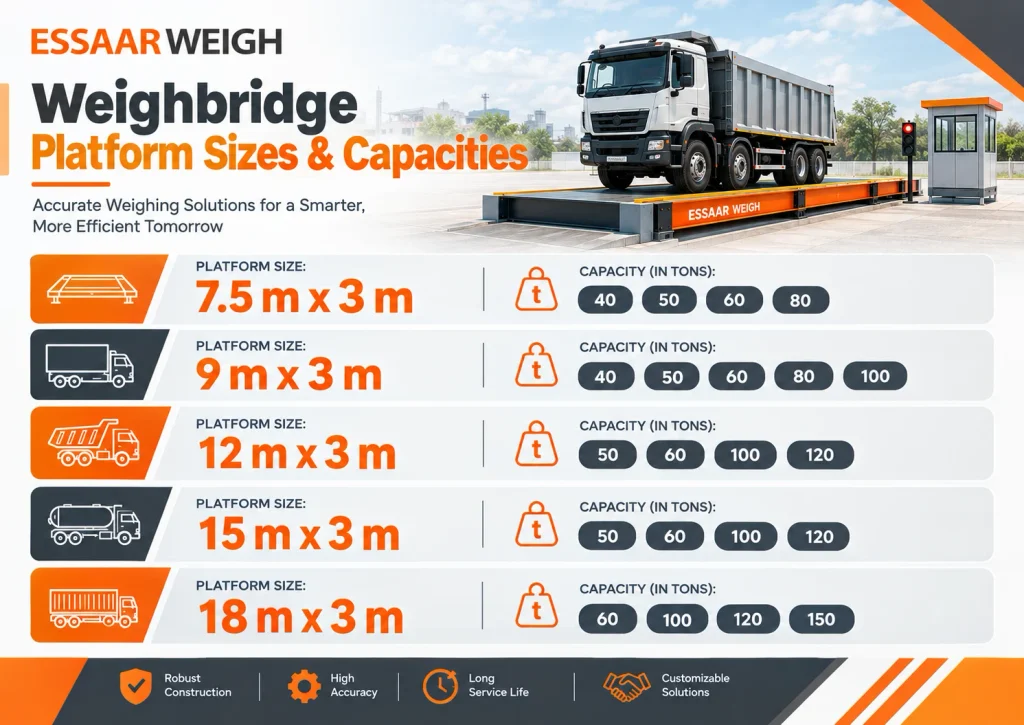
Common Weighbridge Capacities
Weighbridge capacity depends on the type of vehicles and materials being handled. Industrial systems are available in different capacities, including:
- 50 Ton Weighbridge
- 60 Ton Weighbridge
- 80 Ton Weighbridge
- 100 Ton Weighbridge
- 120 Ton Weighbridge
- 150 Ton Weighbridge
- 180 Ton Weighbridge
The suitable capacity should be selected according to the maximum vehicle weight and expected operating conditions
Where Are Weighbridges Used?
Weighbridges are used in many industries where vehicle loads need to be measured accurately.
Manufacturing Industries
Manufacturing plants use weighbridges to record incoming raw materials and outgoing products.
Logistics and Transportation
Logistics companies use weighbridges to monitor vehicle loads and maintain proper transportation records.
Mining and Construction
Mining and construction sites use heavy-duty weighbridges for weighing vehicles carrying minerals, aggregates, sand, stone, and other materials.
Agriculture
Agricultural businesses use weighbridges for weighing grains, rice, wheat, fertilizers, and other bulk materials.
Warehouses
Warehouses and distribution centers can use weighbridges to manage incoming and outgoing material quantities.
Benefits of Using a Weighbridge
A properly installed weighbridge provides several operational benefits:
- Accurate measurement of heavy vehicle loads
- Better control over incoming and outgoing materials
- Reduced chances of manual weighing errors
- Easy maintenance of vehicle weight records
- Improved inventory and material management
- Digital data storage and reporting
- Suitable for continuous industrial operations
- Helps monitor vehicle loading and transportation
How to Choose the Right Weighbridge?
Before selecting a weighbridge, businesses should consider several factors:
Capacity: Select a capacity according to the maximum loaded vehicle weight.
Platform Size: Platform dimensions should match the length and type of vehicles being weighed.
Installation Type: Choose pit, pitless, or mobile construction according to the available site and operational requirements.
Load Cells: Reliable load cells are important for consistent weighing performance.
Construction: The weighbridge should have a robust structure suitable for the expected traffic and environmental conditions.
Weighing Software: For high-volume operations, software with vehicle records, reporting, and data management can improve operational efficiency.
What is the Difference Between Gross Weight, Tare Weight, and Net Weight?
These three terms are commonly used in daily weighbridge operations. Gross weight is the total weight of a loaded truck, including the vehicle and the material. Tare weight is the weight of the empty truck. Net weight is the actual weight of the material carried by the truck.
Net Weight = Gross Weight – Tare Weight
For example, if a loaded truck weighs 48,000 kg and the empty truck weighs 16,000 kg, the actual material weight is 32,000 kg. This net weight is used for billing, stock records, dispatch, and material tracking.
Manual Weighing vs Digital Weighbridge Systems
Manual weighing depends on writing weight details and maintaining paper records, which can lead to entry mistakes and missing information when truck movement is high. A digital weighbridge records weight data electronically and can be connected with weighing software, printers, cameras, and other systems.
Digital weighbridge systems help businesses maintain accurate records, reduce manual errors, generate weighment slips, and manage vehicle and material information more easily. For industries with regular truck movement, this makes the weighing process faster and more organized.
How Weighbridges Support Digital Operations in 2026
Modern weighbridges are becoming an important part of digital industrial operations. When connected with software and other systems, they can provide useful data about vehicle weight, material movement, suppliers, dispatches, and weighing transactions.
This helps businesses improve inventory control, logistics management, billing, reporting, and overall operational efficiency. A modern weighbridge is therefore not only used for measuring truck weight but also works as an important data point for industrial operations.
Why Choose Essaar Weigh for Weighbridge
Essaar Weigh is a trusted name in industrial weighing solutions, known for providing high-quality and reliable weighing systems for different industrial applications. We focus on strong construction, accurate weighing performance, easy operation, and solutions designed according to the specific requirements of our customers. Our weighing systems are suitable for industries where regular and accurate measurement of heavy vehicles and materials is required.
Businesses and industries looking for a reliable and high-performance weighbridge solution can contact Essaar Weigh, one of the trusted Weighbridge Manufacturers in Ghaziabad, India. We provide robust weighing systems designed for accurate weight measurement, regular industrial use, and different vehicle and capacity requirements.